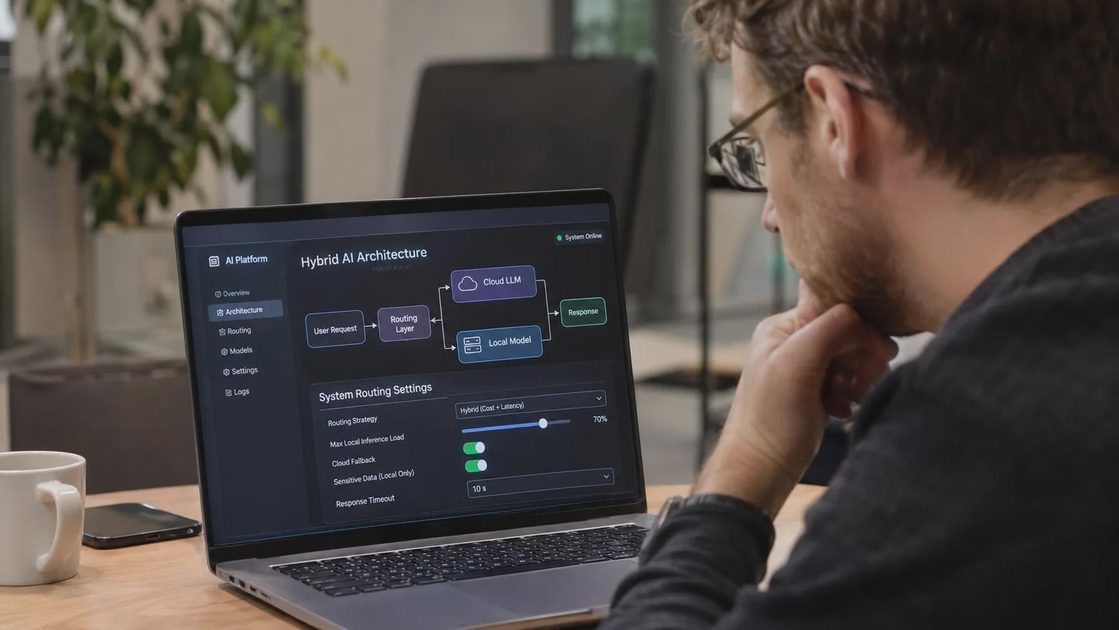
Siri AI, the rebuilt assistant powered by the next generation of Apple Intelligence, routes requests across a hybrid architecture. Some work stays entirely on the device. More demanding requests move to Private Cloud Compute. Within the on-device tier, a basic model and a higher-capability advanced model coexist, with the advanced tier limited to newer silicon and higher memory thresholds.
This matrix focuses on the documented distinctions that matter in daily use and for evaluation. It builds on the overview in Siri AI: What’s Confirmed, What’s Restricted, and What It Means in Practice and sticks to verified architectural and support details.
The Two Primary Axes
Apple’s design separates processing location from model capability.
Location axis
On-device: Apple Foundation Models running locally. No data leaves the device for these requests.
Private Cloud Compute: Server-side processing under Apple’s privacy architecture. Personal data is used only for the request, is not stored, and is not made accessible to Apple. Outside experts can continue to verify the claim.
Capability axis
Basic on-device model: Available across the broader set of Apple Intelligence-supported devices.
Advanced on-device model: Restricted to newer devices with higher unified memory (roughly the A19 Pro / M3-or-later class with sufficient memory). It enables more expressive voices and improved system-wide dictation accuracy.
Cloud models handle the requests that exceed on-device capacity. The system orchestrator decides the route; users do not manually choose the tier for most interactions.
On-Device Processing: What Stays Local
Simple device control, personal-context lookups, and many cross-app actions remain on the device.
Typical on-device work includes:
Setting timers, alarms, and system settings
Searching personal data across Messages, Mail, Photos, Notes, Calendar, and similar sources
Onscreen awareness (questions or actions related to what is currently visible)
Core app actions that the system can complete without external knowledge
Basic conversational follow-ups that stay within local context
Because nothing leaves the device, these requests work offline and carry the strongest privacy posture. Hardware generation still matters: older Apple Intelligence devices run the basic on-device model; only the higher-spec devices unlock the advanced on-device model and its voice and dictation improvements.
Private Cloud Compute: When the Request Leaves the Device
More sophisticated requests—those requiring greater reasoning capacity, broader knowledge, or heavier generation—are routed to Private Cloud Compute.
Examples include longer-form generation, complex multi-step reasoning that exceeds local model capacity, and certain world-knowledge queries that need current external information. Apple states that personal data processed in this environment is not stored and is not accessible to Apple. The architecture is designed so that independent verification of the privacy claims remains possible.
In the current generation, some of the heaviest cloud work can run on third-party infrastructure under the same Private Cloud Compute rules and protections. The user-facing guarantee remains the same: data is used only to fulfill the request.
Basic vs Advanced On-Device Model
The advanced on-device model is not a separate assistant. It is a higher-capability local model available only on devices that meet stricter silicon and memory thresholds.
Confirmed differences include:
More expressive and customizable Siri voices (pace and expressiveness controls, currently English-focused in documentation)
Noticeably improved accuracy in system-wide dictation
These improvements appear only when the advanced model is present. On devices limited to the basic on-device model, the corresponding features fall back to the lower tier or are unavailable. Apple’s support documentation lists the exact hardware cut-offs; the practical rule of thumb is recent high-memory Apple silicon (M3-class or later Macs and iPads with at least 12 GB unified memory, and the corresponding high-end iPhone models).
Feature Matrix Summary
Capability area | Typical routing | Model tier notes | Offline? | Privacy posture |
|---|---|---|---|---|
Simple device control | On-device | Basic or Advanced | Yes | Maximum (local) |
Personal context search | On-device | Basic or Advanced | Yes | Maximum (local) |
Onscreen awareness & app actions | On-device (many cases) | Basic or Advanced | Partial | Maximum when local |
Expressive voices / advanced dictation | On-device | Advanced model only | Yes | Maximum (local) |
Longer generation / complex reasoning | Private Cloud Compute | Cloud models | No | High (stateless) |
World knowledge / current info | Private Cloud Compute | Cloud models | No | High (anonymized) |
The table is illustrative of the documented patterns rather than an exhaustive per-feature list. Exact routing can vary with request complexity, device capability, and system load. Certain cloud-backed features are also subject to daily usage limits.
Regional and Practical Constraints
Full Siri AI under the global architecture is not available in mainland China; the China path uses a different partner stack for selected knowledge and generation tasks. In the European Union, Siri AI remains unavailable on iOS, iPadOS, and watchOS pending resolution of Digital Markets Act questions, while macOS and visionOS can access it under supported language settings.
Developers integrating with Siri AI should test against the actual device tier and region. Tool calling and multi-step app actions that rely on Private Cloud Compute will not function offline. On-device-only paths remain available when connectivity is absent, but with reduced capability.
Practical Evaluation Advice
Identify the exact device model and confirm whether it supports the advanced on-device model.
Test representative tasks in both online and offline states to observe routing behavior.
For privacy-sensitive workloads, prioritize flows that stay on-device; treat cloud routing as an explicit design decision.
In multi-region deployments, evaluate the China Qwen path and the EU restrictions separately from the global Siri AI matrix.
Monitor usage limits on cloud-backed features if the workload is high-volume.

Bottom Line
Siri AI is a hybrid system, not a purely on-device or purely cloud assistant. Simple and personal-context work prefers the device; heavier reasoning and knowledge tasks move to Private Cloud Compute under documented privacy constraints. Within the on-device layer, an advanced model unlocks better voices and dictation on higher-spec hardware.
The matrix above captures the distinctions that affect real usage. Confirm the hardware tier, test the tasks that matter, and treat regional availability as a first-order constraint. Further refinements to model routing or hardware cut-offs will appear in Apple’s support documentation as the system evolves.



No comments yet — be the first to share a thought.