Apple Intelligence reached mainland China with iOS 27.3 only after a multi-year regulatory process. The final architecture is a split stack: Apple’s own generative models handle the bulk of on-device work, while Alibaba’s Qwen is integrated for selected system-level language, generation, and understanding tasks. This arrangement was not a product preference. It was the direct result of Chinese rules governing generative AI services.
This article expands on the overview in Apple Intelligence Finally Reaches China — With Qwen as the Local Partner. It focuses on the regulatory constraints that made a domestic partner mandatory and on the signals the choice of Qwen sends to practitioners.

The Regulatory Constraint
China’s Interim Measures for the Management of Generative Artificial Intelligence Services, which took effect in August 2023, require every public-facing generative AI service operating in mainland China to complete a formal filing with the Cyberspace Administration of China (CAC) before reaching consumers. The requirement applies to on-device services as well as cloud-based ones.
Foreign companies face an additional structural limit: they cannot simply deploy their own foundation models. They must partner with CAC-approved domestic providers whose models have already cleared the necessary content and compliance reviews. Apple’s own models, trained and operated outside that framework, did not meet the local filing bar on their own.
The practical consequence was clear. To bring Apple Intelligence to Chinese iPhones, Apple needed an approved Chinese model for the portions of the system that regulators treat as generative AI services. Without that partnership, the features could not ship.
The Path to Approval
Apple explored multiple Chinese AI providers. Public reporting indicated discussions with Baidu, DeepSeek, and ByteDance before Alibaba’s Qwen emerged as the primary partner for language and generation tasks. Baidu was also involved for specific verticals such as search.
The CAC registered Apple Intelligence as an approved on-device generative AI service in July 2026, listing it alongside services from Huawei, Xiaomi, OPPO, vivo, Samsung, and Nubia. Apple was the only foreign company on that list. Subsequent network-access permits from the Ministry of Industry and Information Technology (MIIT) cleared the hardware-layer deployment path for the relevant iPhone models.
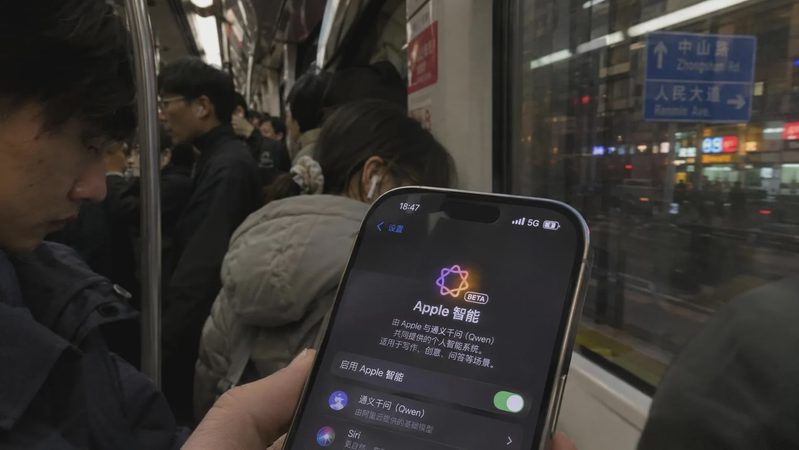
The result is the architecture now shipping: Apple models for the majority of on-device processing, with Qwen available for the scoped hand-offs that require an approved domestic model—certain Siri requests involving documents or photos, Compose with Qwen in Writing Tools, and Ask Qwen in Visual Intelligence. Users control when the hand-off occurs and what data is shared. Alibaba has stated that requests and responses will not be used for model training.
Why Qwen Specifically
The selection of Qwen reflects both regulatory readiness and demonstrated capability. Qwen had already completed the filings required for public deployment. It also offered a model family with sufficient quality for the surfaces Apple chose to expose: document understanding, original text generation, and image-related questions.
Apple’s official statements confirm two points: the base generative models are built by Apple, and Apple is working with Alibaba to add Qwen support inside selected experiences. The partnership is therefore not a full replacement of Apple’s stack. It is a targeted integration that satisfies the local-model requirement while keeping Apple’s own models in the primary path.
This is the first time a Chinese large model has been positioned as a primary system-level partner for a global consumer device maker in the mainland market. That fact itself is a signal about the maturity of the Qwen family under real production and regulatory constraints.
What the Arrangement Signals
For teams already evaluating or deploying Qwen, three practical implications follow.
First, regulatory clearance and product-quality clearance can travel together. Qwen cleared both the CAC content-layer requirements and the quality bar Apple applied for system-level integration. That combination is rarer than strong benchmark scores alone. It provides external evidence that the same model family used in open-weight and API deployments can operate inside a tightly controlled consumer operating system.
Second, the split-stack design is a visible production pattern. Apple kept its own models for latency-sensitive and privacy-sensitive on-device work and limited the external partner to defined hand-offs under user control. Many internal deployments already follow a similar structure—local models for constrained paths, larger or external models for heavier generation. The China architecture makes that pattern concrete at consumer scale.
Third, market access in regulated environments often requires domestic partners. The two-year delay between the global launch of Apple Intelligence and the China release illustrates the cost of navigating those rules. Companies planning AI features for mainland China should treat local-model requirements as a first-order design constraint rather than a late-stage compliance task.
What Remains Outside the Scope
The partnership does not mean every Apple Intelligence feature in China runs on Qwen. Apple’s own models continue to power the majority of the first-wave set. Full Siri AI and certain later capabilities remain absent from this release. Exact model variants, latency characteristics, and detailed data-flow boundaries for the Qwen path have not been published in full; observable behavior in the beta and public release remains the best current source.
The arrangement is also region-specific. It applies to eligible devices whose region and Apple Account settings align with mainland China. It is not a global default.

Practical Takeaways
Chinese generative-AI rules require local filings and, for foreign companies, partnerships with approved domestic models. Apple’s own models alone were insufficient.
Qwen was selected after evaluation of multiple providers and cleared both regulatory and quality thresholds for the surfaces Apple chose to expose.
The resulting architecture is a deliberate split stack, not a full outsourcing of Apple Intelligence.
For practitioners already using Qwen, the integration supplies external validation that the model family can meet production and compliance bars inside a major consumer platform.
Teams planning AI features for China should treat domestic-model requirements as an early architectural decision.
The partnership was driven by regulatory reality. The choice of Qwen, and the limited scope of the hand-off, reflect a practical balance between compliance and product control. That balance is now visible in the shipping software. Further technical details, if released, will refine the picture; the regulatory logic and the resulting architecture are already clear.



No comments yet — be the first to share a thought.