
When Apple Intelligence reaches mainland China with iOS 27.3, Alibaba’s Qwen becomes the approved partner for a defined set of system-level language, generation, and understanding tasks. For teams that already run Qwen models locally or via API, this is more than a consumer product announcement. It is a concrete data point about what the same model family can clear in a tightly controlled production environment.
This piece builds on the overview in Apple Intelligence Finally Reaches China — With Qwen as the Local Partner. It focuses on the practical implications for practitioners who already treat Qwen as infrastructure rather than a novelty.
What the Integration Actually Demonstrates

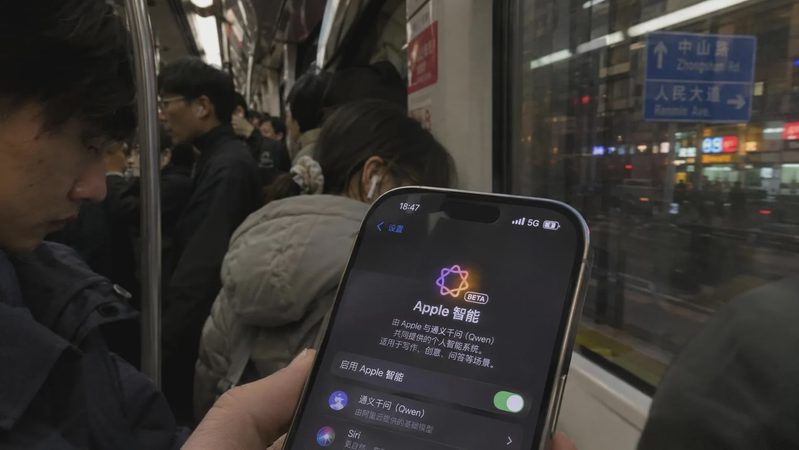
Apple’s own generative models continue to handle the bulk of on-device work. Qwen is positioned for selected experiences: certain Siri requests involving documents or photos, “Compose with Qwen” in Writing Tools, and “Ask Qwen” in Visual Intelligence. Users control when the hand-off occurs and what data is shared. Alibaba has stated that requests and responses from the integration will not be used for model training.
The significance for local-Qwen teams is not that every phone in China now runs an open-weight checkpoint. It is that the same model family used in open-weight releases and hosted APIs has cleared the dual bars of product quality and local regulatory filing required for deep integration inside a major consumer operating system. That combination is rarer than leaderboard rankings.
Signal Strength Over Marketing Language
Teams evaluating models for internal tools or agent systems usually weigh three practical questions: does the model meet quality thresholds for the tasks that matter, can it operate under the constraints of the target environment, and is the provider stable enough for production reliance.
The China integration supplies a positive answer on the first two points for the specific surface Apple chose. Document understanding, original text generation, and image-related questions are the tasks Apple routed to Qwen. These are also common workloads for teams already running local Qwen instances—RAG over internal documents, drafting, and multimodal inspection. The fact that these surfaces were selected, and that the integration reached developer beta on 4 November 2026 and public release timing in December, is stronger evidence than isolated benchmark scores.
It does not prove that every Qwen variant is production-ready for every enterprise constraint. It does show that the family has passed a real-world filter that many other models have not yet faced at this scale.
Implications for Evaluation Practice
Teams that already benchmark Qwen locally should treat the Apple integration as an additional reference point rather than a new requirement.
First, the tasks Apple exposed are worth aligning with. If your internal evaluation suite already includes document QA, long-form generation, and basic visual understanding, the China deployment offers an external calibration: these capabilities were judged sufficient for system-level use under regulatory scrutiny. Gaps in your own suite relative to those surfaces become higher priority.
Second, the split-stack design is instructive. Apple kept its own models for the majority of on-device work and limited the external partner to scoped hand-offs. Many internal deployments follow a similar pattern—local models for latency-sensitive or privacy-sensitive paths, external or larger models for heavier generation. The China architecture makes that pattern visible at consumer scale.
Third, the user-consent layer is a reminder that production systems often insert human or policy gates even when the model is capable. Local Qwen deployments that currently run fully automatic pipelines may eventually need comparable controls if they move closer to end-user or regulated surfaces.
What Does Not Change
The integration does not alter the technical characteristics of the open-weight models available on Hugging Face or the APIs many teams already call. Model sizes, quantization options, context lengths, and fine-tuning workflows remain as they were. Teams that selected Qwen for cost, data residency, or customization reasons still make those decisions on the same grounds.
It also does not guarantee feature parity or identical behavior between the system-level Qwen path and a self-hosted checkpoint. Exact variant details, latency characteristics, and payload boundaries for the Apple hand-off have not been published in full. Observable behavior in the beta remains the best current source for those specifics.
Finally, the integration is China-region specific. Device eligibility, Apple Account region, and language settings constrain availability. It is not a global default.
Practical Next Steps for Local Teams
Revisit evaluation coverage for the surfaces Apple chose: document understanding, original generation, and visual questions. Measure your current local Qwen setup against the same categories.
Treat the consent and routing pattern as a design reference. If your internal tools may eventually serve end users or cross regulated boundaries, design the control points early rather than retrofitting them.
Keep monitoring for technical details. The original overview noted that further information on exact variants and privacy boundaries would be updated if released. Those details matter more for production planning than the announcement itself.
Separate the signal from the surface. The value for local teams is the validation of capability and compliance readiness, not the consumer UI elements.
Bottom Line
For teams already running local Qwen, the China Apple Intelligence integration is useful evidence, not a product change. It shows that the same model family can meet the quality and regulatory thresholds required for system-level partnership inside a major consumer platform. The tasks Apple selected align with common internal workloads. The split-stack and consent design offer a visible production pattern.
Continue evaluating Qwen on the criteria that already matter to your deployment—task performance, resource cost, data control, and operational stability. Use the Apple integration as one more external data point that those criteria can be satisfied at scale under real constraints. The open-weight releases and the system-level partnership are now two ends of the same continuum; the practical work remains in the middle, where most teams operate.




No comments yet — be the first to share a thought.