Apple is shipping two different assistant stacks. Outside mainland China, Siri AI is the rebuilt, personal assistant that runs on Apple Foundation Models, on device where possible and on Private Cloud Compute when the request is heavier. Inside mainland China, the first public Apple Intelligence wave uses Apple’s own base models for a narrower set of features and lets people opt in to route selected knowledge and generation requests to Alibaba’s Qwen.
They are not the same product with a different logo. If you are deciding what a team can rely on in late 2026, compare capabilities that are actually shipping, not the marketing name.
The global picture is covered in Siri AI: What’s Confirmed, What’s Restricted, and What It Means in Practice. The China rollout is covered in Apple Intelligence Finally Reaches China — With Qwen as the Local Partner. This piece only lines the two up.
What each path is
Global Siri AI is a full assistant rebuild. It launched in beta with the iOS 27 and macOS 27 family in September 2026. It understands personal context across apps such as Messages, Mail, Photos, Notes, and Calendar. It can act on what is on screen, run multi-step actions across apps, and keep a conversation in a dedicated Siri app that syncs privately through iCloud. Heavier requests go to Private Cloud Compute. Apple’s position is that data used there is not stored and is not accessible to Apple, and that outside experts can keep checking that claim.
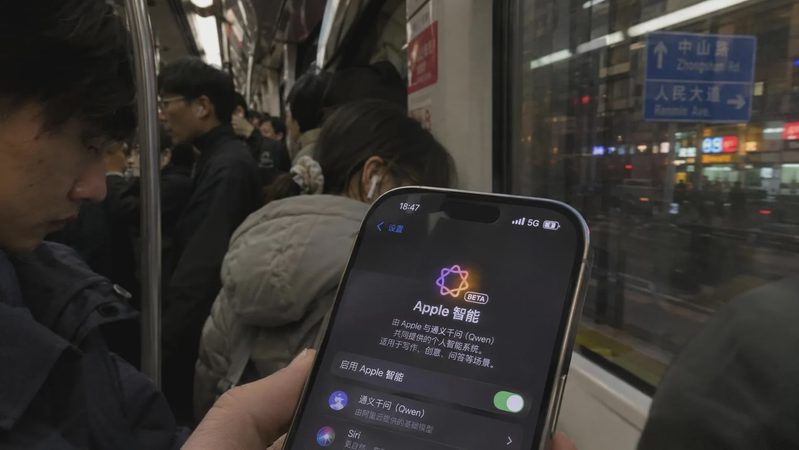
The China Qwen path is a region-specific Apple Intelligence build. Core features entered an open developer beta on 4 November 2026 and are scheduled to ship publicly with iOS 27.3. Apple has said the base generative models are its own, and that it is working with Alibaba so selected experiences can use Qwen. People can opt in to send certain requests — document analysis, photo questions, content generation, “Compose with Qwen,” and “Ask Qwen” in Visual Intelligence — to Qwen. The full global Siri AI suite is not part of this first drop.
Side-by-side: what is live
Capability | Global Siri AI | China first wave |
|---|---|---|
Personal context across Mail, Messages, Photos, and similar apps | Shipping | Not in the first wave |
Onscreen awareness and multi-step app actions | Shipping | Not in the first wave |
Dedicated Siri app with iCloud conversation sync | Shipping | Not in the first wave |
Writing Tools (proofread, rewrite, summarize) | Shipping | Shipping |
Notification and email summaries, Smart Reply | Shipping | Shipping |
Photos Clean Up, memory videos, natural-language photo search | Shipping as part of Apple Intelligence | Shipping in the first wave |
Visual Intelligence | Shipping, broader device entry points | Shipping via the camera; “Ask Qwen” is an opt-in path |
Genmoji / smart emoji | Shipping | Shipping |
Audio transcription and call or message translation | Part of the wider Apple Intelligence set | Shipping in the first wave |
World knowledge and open-ended generation | Private Cloud Compute under Apple’s stack | Opt-in hand-off to Qwen for the documented request types |
Expressive voices and the advanced on-device dictation tier | On higher-memory recent hardware only | Not part of the confirmed China first wave |
The table is a capability map, not a promise that every row behaves identically on every device. Hardware tier, language, and Apple Account region still decide what appears.
What the China first wave actually covers
The confirmed China set is the contained Apple Intelligence surface, not the conversational assistant rebuild:
Photo Clean Up, memory video creation, and natural-language photo search
Visual Intelligence from the camera
Genmoji
Writing Tools for proofreading, rewriting, and summarization
Notification and email summaries
Smart Reply
Transcription and summaries for Notes and phone calls
Live translation for calls and messages
Qwen is not the model behind every one of those. Apple’s statement separates two layers: Apple-built base models, and Qwen as the partner for specific Siri-related and multimodal requests that the user chooses to send. Treat “Compose with Qwen” and “Ask Qwen” as explicit routes, not as a silent replacement of the whole assistant.
Daily use of this set is covered in Apple Intelligence China First-Wave Features: What Actually Works in Daily Use. The opt-in boundary is covered in How the Qwen Hand-off Works in Apple Intelligence China.
What global Siri AI still does that China does not
Three gaps matter more than feature-list length.
Personal context. Global Siri AI can look across the user’s own messages, mail, photos, and calendar to answer a question about something they already have. That is the feature people mean when they say the assistant “knows what is on this phone.” It is not in the China first wave.
System-wide actions. Drafting, editing, and chaining steps across apps, plus answering questions about the current screen, are part of the global assistant. The China drop stays inside named tools: writing, photos, summaries, translation, visual questions.
The conversation product. The dedicated Siri app and private iCloud history sync exist on the global path. China does not ship that assistant shell in this wave.
There is also a hardware split on the global path that China has not mirrored in public documentation. More expressive voices and the stronger on-device dictation model require newer silicon and higher unified memory. Devices that only qualify for the basic on-device model do not get that tier. Do not assume the China build inherits the same advanced on-device cutoff until Apple documents it.
Architecture, not just features
Global routing is a hybrid inside one privacy design. Simple and personal tasks stay on device. More demanding reasoning and world-knowledge requests go to Private Cloud Compute. The system orchestrator and on-device indexes (including Spotlight and the app toolbox) keep a large share of actions local. Some cloud-backed features have daily usage limits, with paid expansion indicated for later.
The China design is a split stack. Apple’s models cover the on-device and narrowly scoped features. Qwen is a separate, user-controlled destination for the request types Apple has named. That is why teams already running Qwen on their own hardware should not treat the phone integration as “our model, now inside iOS.” The weights, the endpoint, the logging, and the retention rules are not the same deployment. See What the China Qwen Integration Means for Teams Already Running Local Qwen.
Why the split exists is regulatory, not a model-quality contest. Mainland China requires a domestic path for this class of generative feature. Apple’s partnership is the way the company is meeting that constraint. The policy context is in Why Apple Partnered with Qwen.
Region still gates both paths
Global Siri AI is itself uneven. It is not available on iOS, iPadOS, or watchOS in the European Union while Apple and regulators disagree about Digital Markets Act interoperability. macOS and visionOS in the EU can use it when the language is supported. Mainland China does not get that global configuration at all.
Language and Apple Account region both matter. A supported language setting does not override a restricted account region. The practical checklist is in Device, Region & Apple Account Checklist for Apple Intelligence China.
Supported global languages as of the late-2026 expansion include English, French, Japanese, Korean, Portuguese, and Spanish, with more planned. Confirm the current list on Apple’s support page before you write a rollout plan around a specific language.
How to evaluate without mixing the stacks
Use the path that matches the job.
Choose global Siri AI when the work is personal context, onscreen actions, or multi-step work across Apple apps, and when the devices are in a region where that assistant actually ships. Test on the real hardware tier. The advanced on-device model is not universal.
Choose the China first wave when the work is writing assistance, photo cleanup and search, summaries, transcription, translation, or an explicit Qwen hand-off for a document or a visual question. Do not write acceptance tests for personal-context Siri or the dedicated Siri app against a mainland China device on this release.
If a product must run in both places, keep two test matrices. A green result on a U.S. or Japan iPhone does not transfer to a mainland China Apple Account, and the reverse is also true.
For developers, the durable global change is the integration surface: app actions and system context, opened more widely in the early November 2026 betas. That surface is part of Siri AI, not part of the China first-wave feature list. Ship China against the documented tools. Ship the assistant integration only where Siri AI is actually available.
Bottom line
Global Siri AI is a personal, multi-step assistant with a hybrid on-device and Private Cloud Compute design. The China path is Apple Intelligence’s narrower toolset, plus an opt-in route to Qwen for specific knowledge and generation requests. Same company, same OS generation, different capability and different data path.
Compare them on the tasks you will actually run, on the account region you will actually use, and on the device tier you will actually buy. Everything else is a screenshot from the other market.
No comments yet — be the first to share a thought.